


I’M IN LABOR
I am 40 weeks pregnant right now. Sitting in the hospital room, laboring. It’s my fourth time birthing a child, unmedicated. I know what comes after this moment of calm and reflection. Indescribable and unwavering pain. Incomprehensible despair. A deep belief that I can’t move forward. Then a euphoric feeling words won’t describe once the kid is out. As my friend Marzyeh put it a decade ago: “You will feel like you are breaking. Then broken. Then they put the baby on you and you will feel complete.”
It’s bittersweet. This will be my last labor.
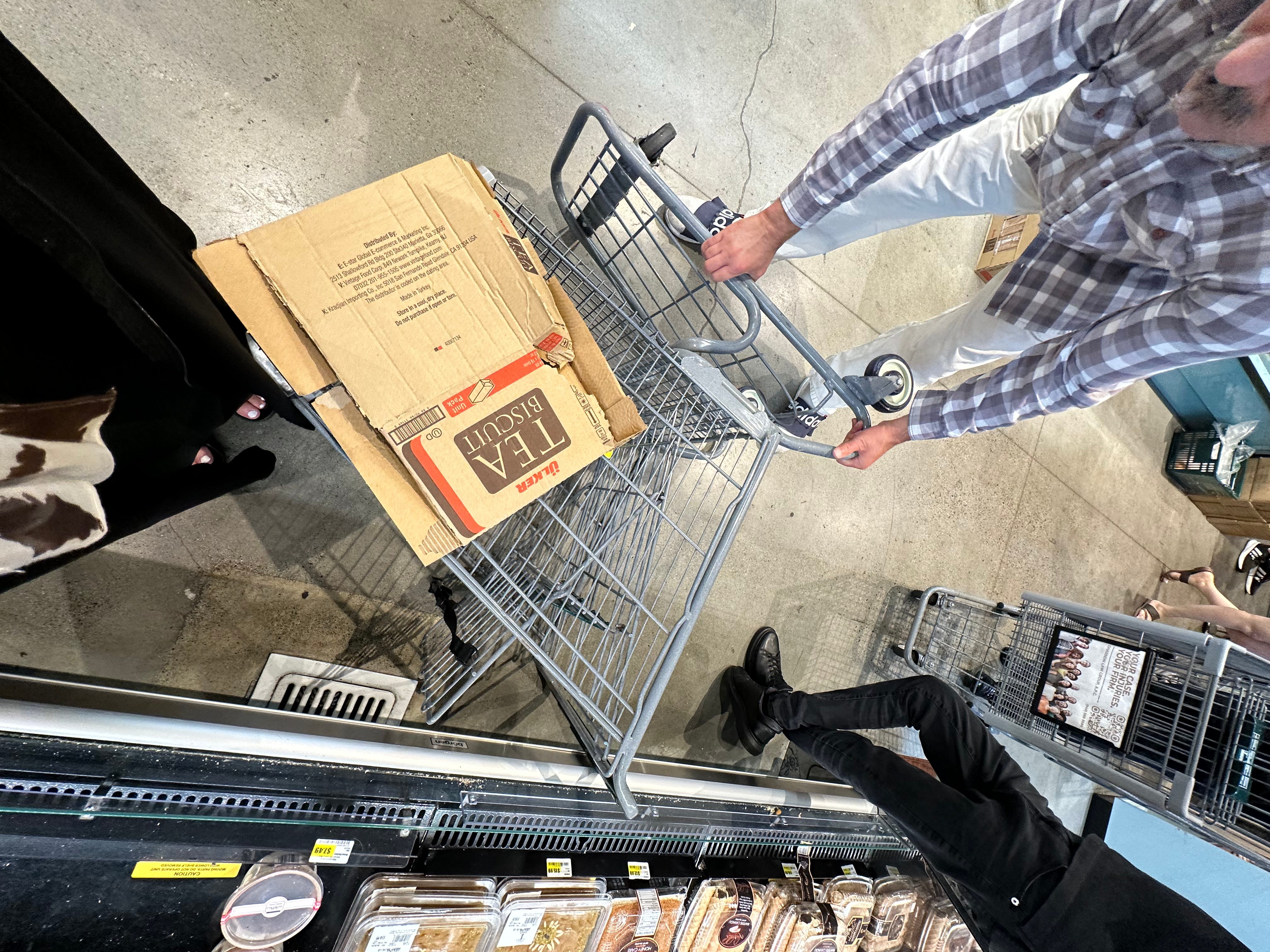
I have been thinking about last-times a lot recently. I was in the breadline at the local Iranian market, patiently waiting thirty minutes for fresh sangaak bread. About ten minutes in, my swollen, pregnant feet couldn’t take it anymore. I started to lean, adjust, and try to find ways to get comfortable. An older man saw me and hurried to grab the closest grocery cart in line (bless the cart’s rightful owner behind me for going along with this), and flipped the cart sideways. He demanded I sit, and reminded me that my job — carrier of life — was more important than social decorum. I sat, gratefully. I also knew that everybody around me would understand — because pregnancy is this oddly mammalian time, when your protection and comfort becomes social obligation that transcends age, race, gender, and even rules of social engagement. Strangers can and will help you. Strangers can and will flip carts for you. Strangers can and will watch their cart get flipped by other strangers in a bread line, and get with the program.
That bread line last week was probably the last time a stranger will defy social norms for me to rest with full buy-in of everybody in eyesight. I won’t be 9 months pregnant ever again.
Some lasts are predictable, some are voluntary, others are neither predictable nor voluntary.
My friend’s father got a terminal prognosis for his cancer; she was preparing for his last Father’s Day recently. She didn’t choose this last and couldn’t predict it. Another friend just divorced her husband. Last year was her last Father’s Day with him. And she could have predicted it, as she was researching divorce attorneys at that time.
Then there’s labor. What I am going through now. The most painful and magical experience of my whole life. The best and worst day of my life. Hours of absolute horror for a lifetime of indescribable joy. Today is the last time I’ll experience labor.
You may be thinking I am crazy to be writing mid-labor. But it’s by design. (And it will stop working really soon, as labor is one of the few human experiences specifically designed to override cognitive control. But I am coherent at the moment).
Everything ends. The bread line ended. My friend’s marriage ended. The labor will end. What you do with the moment after is the only variable you own.
Have you thought about a last time that has that slipped you by? I anecdotally read the last time most Americans sprint is before 30.
EMOTION IS QUICK
Every time I feel a contraction, as my body pushes the baby’s body down, I reel in pain. Soon, I will shudder in terror. The pain of a single late stage contraction is comparable to getting bit by a pit bull, with the concentrated jaw bite force of over 200 pounds driven by massive skeletal muscles. My uterus — a smooth, involuntary organ (i.e. one you can’t tone), ounce for ounce, is generating a squeezing and expulsive force that rivals the grip intensity of highly powerful jaw muscles.
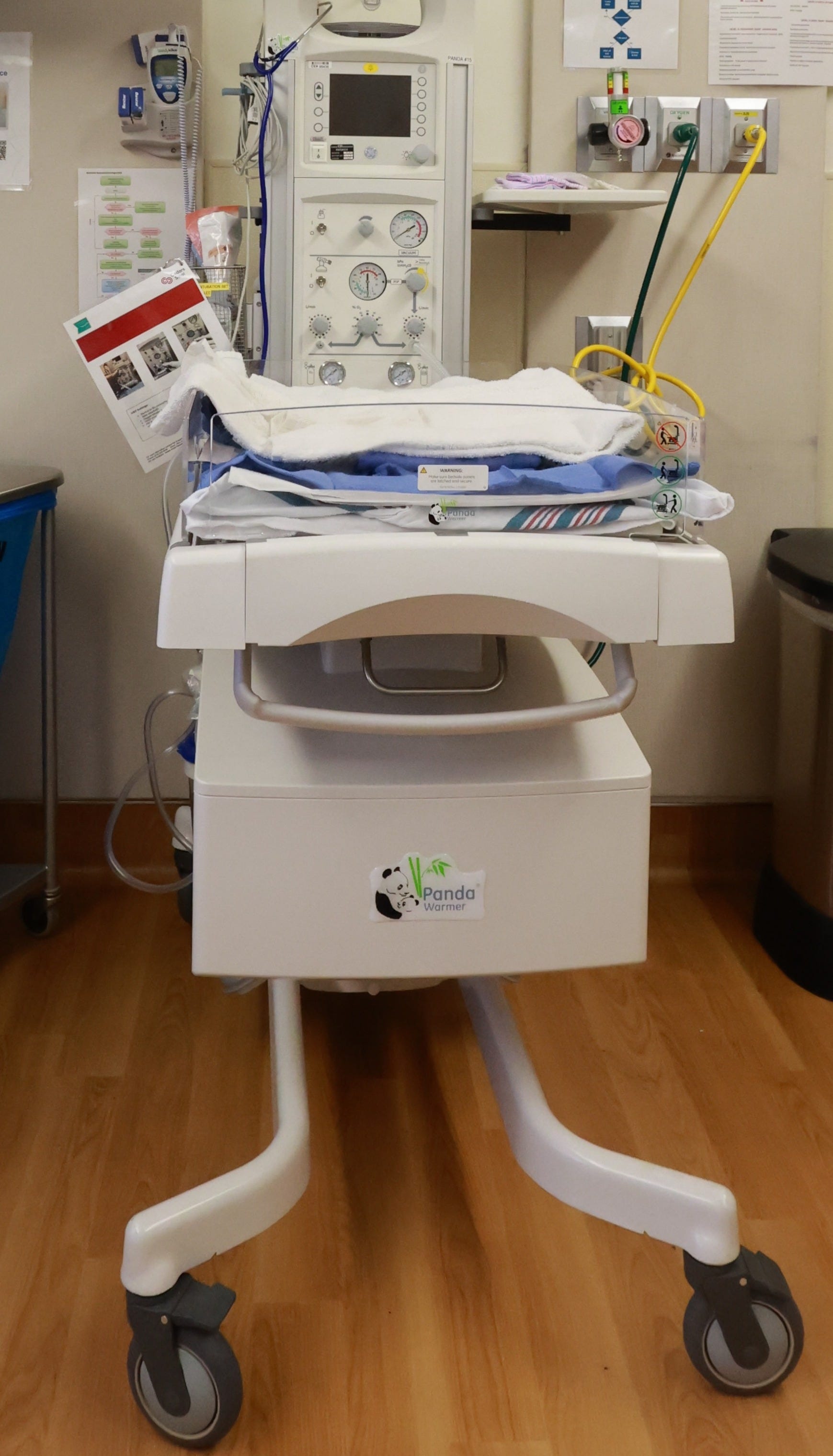
Every few minutes. If I don’t get my mind off the contractions in the moments of reprieve, I will repeat the pain loop in my head. And the anticipation of what’s ahead, because I know it will get worse. That’s why I write. Sometimes I chat with my husband. Other times I stare at the cute, empty tray of baby stuff — ready to receive the human currently nested in my uterus. The most salient reminder that this will all be over soon.
I was reading about biological responses to triggers recently. And how when a trigger occurs — pain, threat, shock — the brain releases a chemical surge. The amygdala evaluates it fast. From the moment your brain perceives a trigger, an initial surge makes your heart race and your body brace. It peaks and begins to subside in roughly 90 seconds. Harvard neuroanatomist and stroke survivor Dr. Jill Bolte Taylor describes this 90 seconds as a process in which the emotional chemical flush is washed out of your bloodstream. If you don’t feed it, it dissolves on its own.1
If you are still furious, anxious, or deeply sad after 90 seconds, it isn’t because the initial biological trigger is still firing. It’s because your thoughts are restimulating the loop. Your mind is telling a story about the event. “How dare they say that,” “What if this happens?” — which triggers a brand-new 90-second chemical wave.
We don’t stay tied to our pain because of the sensation. We stay tied to the pain because of the fear of the sensation, the anticipation of it — whatever story we are telling ourselves about the pain. So I can push past the fear of the next contraction, or I can anticipate it in terror.
So I write.
And the contraction passes. But in that reprieve, I keep coming back to the same question: if the biology resets, why do we often choose the loop?
Team! I am going to turn on payments soon, you won’t get less of me. I am committed to access. But those who subscribe will get more of me. Why? I have been working on a book — and as my commitments increase (4th baby, lol) and time decreases (4th baby, lol), I’ve been committed to making sure the work is top tier (especially at a time when AI is threatening how-to nonfiction). Which has involved paying other people to push my ideas and help me develop. So, consider pledging for when I turn it on.
The pledges are at a discounted rate, to show my appreciation to those of you who pledge before my subscriptions are on.
WHEN WE SUCCUMB TO EMOTION, WE LEAN ON DESIRE AND NOT CAPACITY
Emotional loops aren’t always self-generated. They can be a result of the systems we were born in. A difficult parent, a chronic pain condition — a constant external trigger. Sometimes the loop is imposed, but my point is to explain how the loop works.
For now, we are going to tackle the loops we have more control over. Understanding the 90-second biological loop helps us understand our capacity, and whether or not we have bogged down our capacity with unregulated emotions.
When we succumb to the loop, we lean on how we feel instead of what we have the tools to work through. Wanting something is about desire, intent, or preference. Capacity is about resources, bandwidth, and neurological/emotional capability.
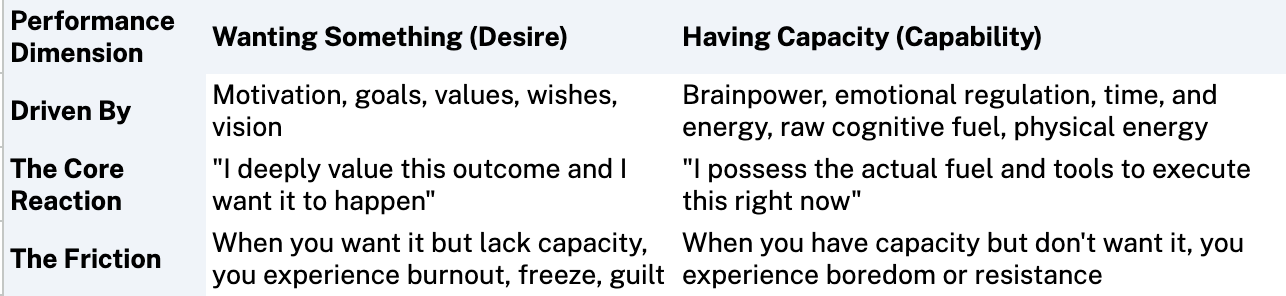
Capacity is what enables executive function. Executive function and emotional flooding are neurologically incompatible. When the amygdala is highly activated, blood flow is redirected away from the prefrontal cortex — the part of your brain responsible for planning, judgment, and capacity. You cannot access your full cognitive bandwidth while emotionally flooded.2
So, reminding myself that the emotions due to the pain are quick is how I remind myself that I have capacity. Capacity is not desire. I can genuinely want to stay perfectly calm, write a good article, or clear my brain for whatever’s next. But if executive functioning is depleted, or the emotional nervous system is flooded, I will lack the capacity in this moment to do it.
In another context, I was recently talking to a friend who got a friendly message from someone who upset her a decade ago. “I don’t forgive or forget,” she went on. “Why should I?”
Because every time you replay the trigger that upset you, you restart the loop, I told her. You’re not punishing the person who hurt you. You’re dosing yourself with the same chemical wave, over and over, for something that happened ten years ago.
Your biology doesn’t know the difference between the original event and the memory of it. It just responds to the story you keep telling. Releasing the story isn’t about excusing what happened. It’s about getting your bandwidth back.
Desire can be a signal that you want more. But awareness is not restoration, and capacity requires work.
In the context of childbirth, endless literature reminds me that my body will perform — and I just have to follow my body or the advice of a medical professional if my body isn’t performing. That women have given birth in comas. That the pain of a contraction is my body doing its intended function of pushing a tiny human through me. A big, arduous task. The literature reminds me that my body is superhuman at this very moment. The literature reminds me to get control of my head, breathe through the pain, and trust my body. That even if I don’t believe it, my body does have capacity and will push forward without me.
(Broad brushstrokes — there are labors where the body doesn’t perform and medicine has to. And yes, hormones are about to override everything I just said. But the principle holds outside this room.)
And usually, if the capacity is there, the headspace can follow.
Recognizing that you lack the capacity for a thing — rather than assuming you don’t care enough or haven’t tried hard enough — changes how you solve the problem. You stop trying to increase motivation and start focusing on restoring resources.
The baby tray is still empty, the contractions keep coming, and — still — I write.
Hi from labor! How are you all doing? It’s been a very on-and-off few weeks with prodromal contractions, hopefully I will be on the other side soon! Leave a comment or some love, I can use the endorphins.
Taylor, J.B. (2008). My Stroke of Insight: A Brain Scientist’s Personal Journey. Viking Press.
Arnsten, A.F.T. (2009). Stress signalling pathways that impair prefrontal cortex structure and function. Nature Reviews Neuroscience, 10(6), 410–422. https://doi.org/10.1038/nrn2648
Writing about the loop we choose to keep feeding made sense to me. I've spent years working with a physician and teacher who said essentially the same thing from clinical observation — that most sustained suffering isn't the original wound anymore, it's the story we keep telling about it. He called it the misery pit. The biology resets. We're the ones who climb back in.
His answer to your question — why do we choose the loop — was practical rather than philosophical. He said the first move is simply recognizing the train before it reaches the pit. Not analyzing why you got on it. Not revisiting the original wound. Just — I know where this train goes. I've been there. There is nothing new to find at the bottom. Stop the train now.
The second move was what he called flipping the switch. Not suppressing the feeling but actively redirecting toward something real and present — something you actually have, not something you've lost or fear losing. He was emphatic that this works faster than people expect, but only after it has been rehearsed. You can't flip a switch you've never practiced finding.
The third thing he said — and this is the one that stayed with me — is that some people don't actually want to leave the loop. There is a hidden purpose being served. The illness, the grief, the anger — it is doing something for them. Excusing them from something. Proving something about someone who hurt them. Until that hidden purpose is named and given up, the loop continues regardless of what else you try.
Your 90-second observation is the biology underneath all of that. He was working from the clinical surface down. You're working from the neuroscience up. Good luck on the new addition. Congratulations.
A little off topic, but I was in a very similar situation 10 years ago. I gave birth to my daughter at 40 weeks and 7 days, so basically 41 weeks.
Some of my friends gave birth just a little earlier, and their babies made the US school cutoff before August 31. I remember crying because my daughter missed it by just a few days. It meant that when she started Grade 1, many of her friends were already in Grade 2.
Then life surprised us. When we relocated to the UK last year, the different school system meant my daughter was placed in Year 4, the same year group as all those friends again. 🤣
Well, life is like a box of chocolates. You never know what you’re going to get next.
One more funny thing: I gave birth on Labor Day. So I was literally in labor on Labor Day. 🤣🤣