


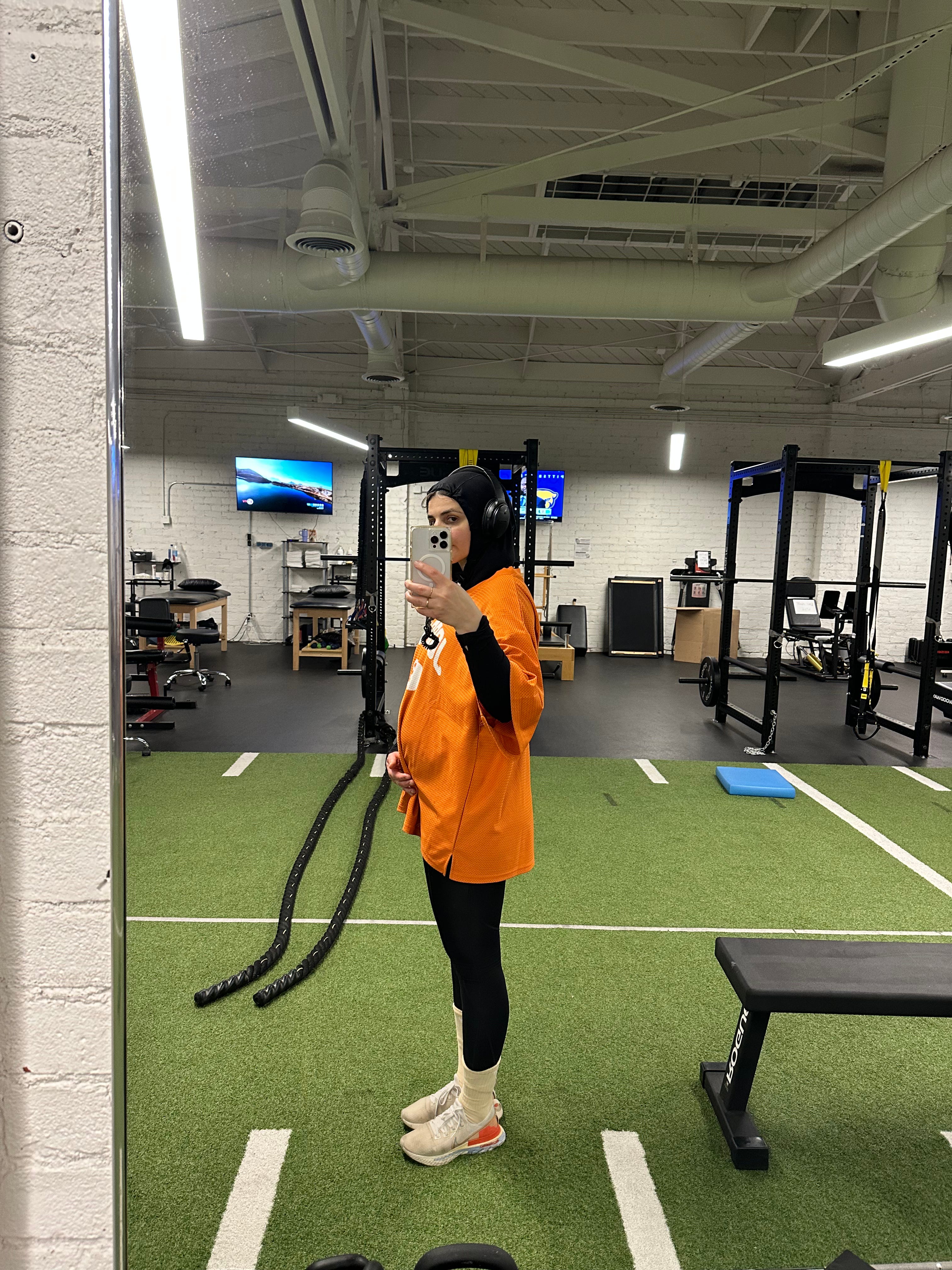
This morning, I went to the gym at six months pregnant for my routine lifting class. Even though I usually love to lift, today I was dragging my feet until the class started. My energy stayed low throughout. Instead of a 25 pound dumbbell set, I opted for 10. I am not usually one for shortcuts, so I mentally beat myself up — but still listened to my very tired body.
I take pride in being a hotshot at the gym. I like staring at my round belly as I challenge myself — being the pregnant woman to farmer carry huge loads, defying what people expect. Even though I was panting at 10 pounds, I felt like I had cheated the gym.
As I lazily carried myself out, I checked Instagram for my weekly AMA. Someone asked: “How do you mentally prepare for birth? I’m not even pregnant, but you are a superwoman.”

As I thought about the response, I realized the mental preparation I apply to birth is the same mental preparation I apply to everything. The 100 pound farmer carry may be a revenue number, a title, a pace to run at, a role to perform at work.
Here is how I do hard things.
FIRST, I UNDERSTAND THE BODY
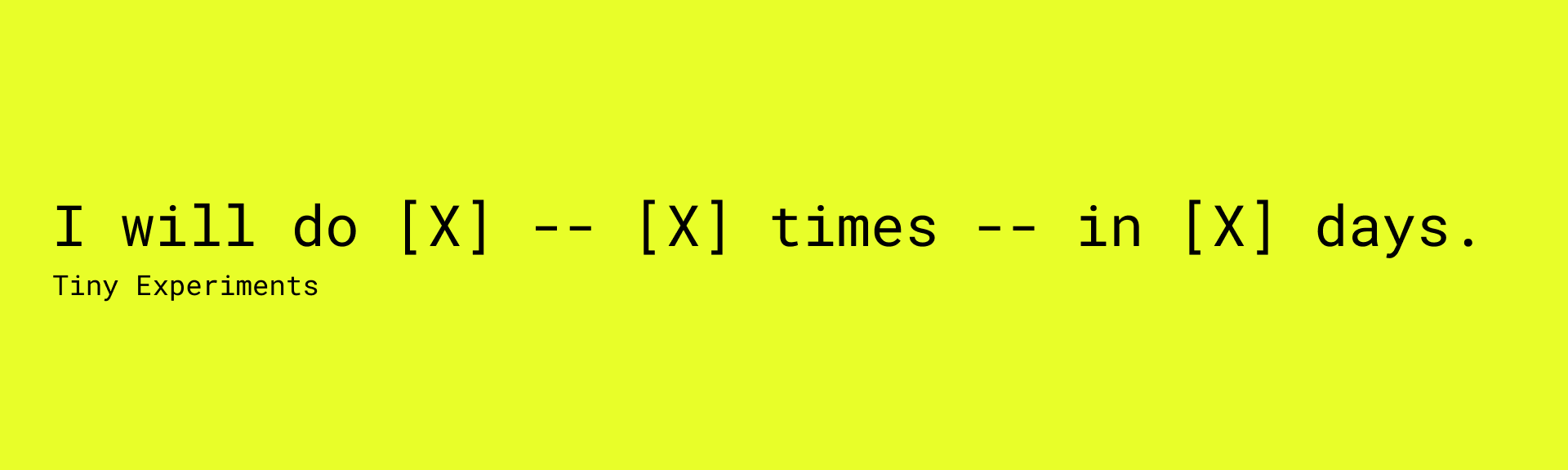
I recently changed my perspective on goal setting, thanks to a book called Tiny Experiments. The author’s argument is that we set goals based on outcome over output. When we focus on outcome, goals become identity-based — so we scan for failure. When we focus on output, we slip into routine easier and actually commit. She recommends this one sentence:
I will do [X] -- [X] times -- in [X] days.
Your brain treats a goal like a threat. It scans for failure. But an experiment doesn’t put your identity on the line. The shift from “I have to” to “let’s see” lowers cortisol and keeps your prefrontal cortex online — the part of your brain that governs executive function: planning, impulse control, rational decision-making. The part that even mild stress impairs by flooding it with dopamine and norepinephrine.1 When goals are framed around avoiding failure, the brain activates a threat response — narrowing attention and impairing decision-making. When goals are framed as approach-oriented, performance and persistence improve. This is the direct neuroscience behind why outcome-based goals backfire — and why “let’s see” outperforms “I have to.”2 Instead of testing your worth, you’re testing a variable.
Sometimes when you think you lack motivation, you actually just lack a low enough bar.
Another book I recently read doubles down on why dropping from a 25 pound weight set to 10 pounds was so hard — it required separating my identity from my performance. I was no longer the pregnant woman who defied odds at the gym. I was the pregnant woman you should probably carve out space for because her pace is, understandably, slower (which is exactly what happened — people went out of their way to clear space out of courtesy, and I was also probably an obstacle). Per Do Hard Things, real toughness isn’t about ignoring signals. It’s about having the security to respond to them without ego interference.
When people tie identity to performance outcomes, they systematically avoid challenges that might disrupt that identity as a form of self-protection.3
SECOND, I GET CONTROL OF MY MIND
My gym commitment is a tiny experiment, not a goal. As a pregnant woman healing a torn ACL, I will lift three times a week for the rest of my pregnancy. Period.
Small, low-stakes behavioral commitments activate reward pathways more reliably than large ambitious goals — because they remove identity threat from the equation entirely. The nervous system responds to evidence, not declarations. Confidence built on performance is fragile by design. Confidence built on the lived experience of surviving discomfort compounds. Every time you stayed when it was hard, every time you came back anyway, you made a deposit into your nervous system.
It’s worth saying that the commitment is often boring or hard.
Earlier in our startup journey, I was on the phone with an advisor. “How do you like the new initiative?” she asked. “Firing on all cylinders,” I answered reflexively. “Funny you say that,” she said, “because that’s not what it looks like. You are slumped, you have been off — and it honestly looks like someone flipped you upside down, shook everything out of you, and flipped you back over.”
I fessed up that I hated what I was doing, but the business needed it.
Her response: “You’re an architect who likes to build and you aren’t building. So you are bone dry. No dopamine hits. Layla, you have to navigate this -- because otherwise your energy will be contagious. Your conviction, your body language. All of it.”
Sometimes it sucks. But something sucking doesn’t mean you can’t do it. And something sucking doesn’t mean you can avoid it to get to the other side. My advisor’s point was about navigating a commitment, even when I hated it. Which takes me to step three.
What do you think so far?
THIRD, I REALLY THINK I CAN DO IT
Controlling my mind got me through the boring days at the startup, but building true self-belief required something more public: standing my ground when the world started looking at me.
The sequence is not fail → improve → feel great. The sequence is fail → stay → develop the knowledge that you can handle what comes next — because you have seen your best and your worst, and pulled through both.
Confidence is seldom a reward for getting good at something. It’s the residue of not quitting.
I want to tell you about the decision that should have made me less confident — and did the opposite.
I tell young, career-oriented Muslim women that even though society told us hijab would be a disadvantage in a post-9/11 world, it has proven to be the opposite for me. Wearing hijab decoupled how I project my identity from what’s socially acceptable. It removed society’s belief in me — that’s how stereotypes work. The mix of my high agency over my own identity and society’s low bar made it easy to stand out. The result: I am confident.
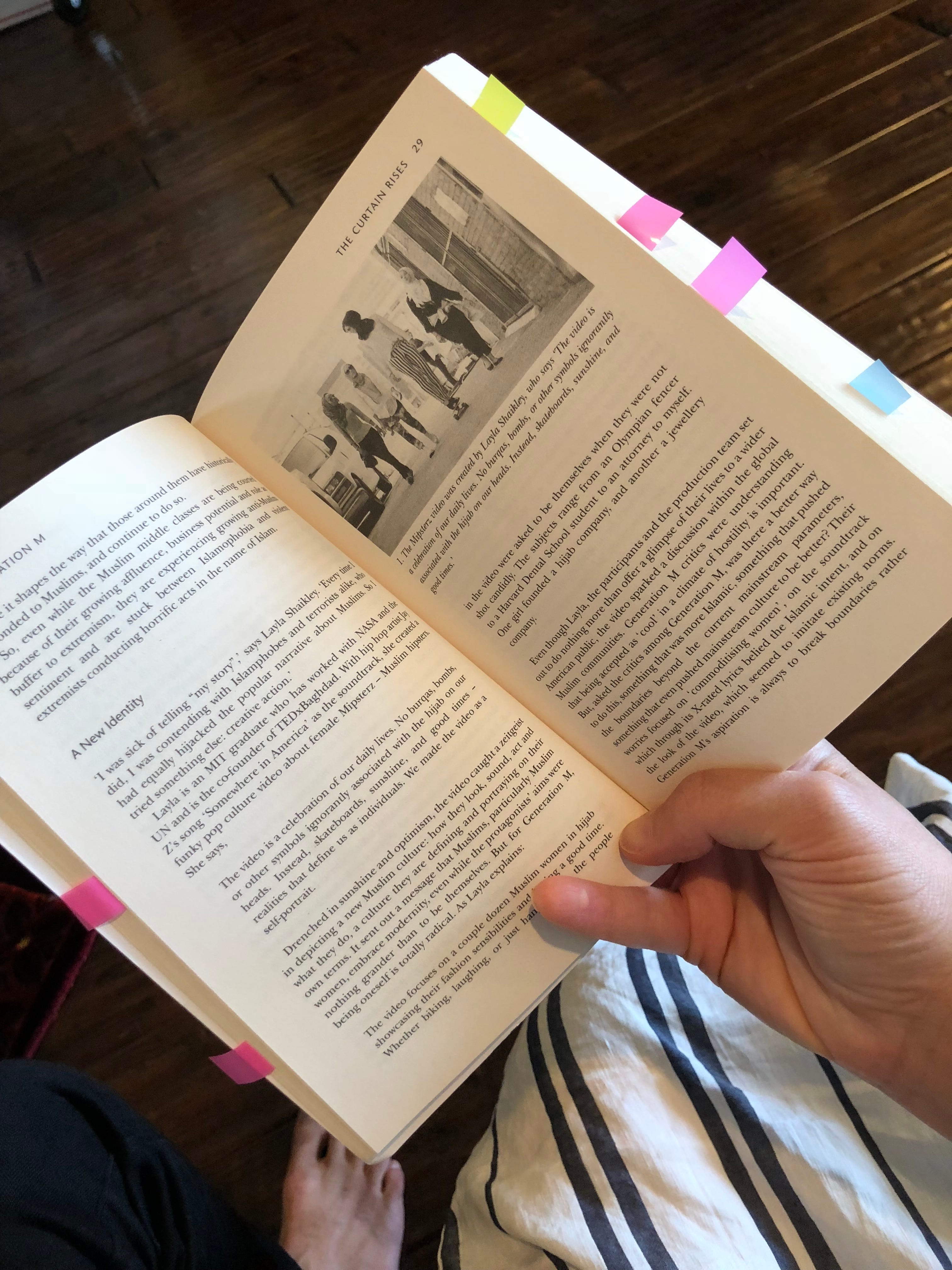
This all came to a head when I went viral for the Mipsterz music video in 2012. Over a million views overnight. I was a hijabi skateboarding in heels, representing joy — and the commentary was immediate, from peers and strangers alike, all of whom had opinions about how I presented myself. It tore open something old — a deep, misplaced fear of being seen that I had subconsciously developed. I had spent years seeing hijabis become conditioned to stay small, to avoid being affiliated with terrorism by association. And there I was, visible.
When I walked into my advisor’s office at the MIT Media Lab, he didn’t let me hide. “Layla, write about this before someone like me does. Here is what’s going to happen: you are going to write a first draft. You are going to hate it. You are going to throw it away. You are going to write a second draft. Then you will send it to me and I will get it published in The Atlantic.”
That is exactly what happened. Not because I was told to be. Because I accumulated evidence that I could handle the gap between how I was perceived and who I actually was.
Confidence is a lagging indicator, not a leading one. It confirms a trend after it has already happened. We have built an entire self-help industrial complex around manufacturing confidence as a precondition — feel good first, then go. That is scientifically backwards.
Confidence is not an input. It’s an output.
And it’s an output that comes from a lot of failure, but even more self-belief.
Thanks so much for reading! Leave a ❤️ or a comment and let me know what you thought! If you have an ERG or group you want me to speak to, lmk here.
Arnsten, A.F.T. (2009). “Stress signaling pathways that impair prefrontal cortex structure and function.” Nature Reviews Neuroscience, 10, 410--422
Higgins, E.T. (1997). “Beyond pleasure and pain.” American Psychologist, 52(12), 1280--1300.
Dweck, C.S. & Leggett, E.L. (1988). “A social-cognitive approach to motivation and personality.” Psychological Review, 95(2), 256--273.
This is what i needed! Im so inspired, Thanks for amazing content🥹🫶🏻
Per usual, LOVED this!! Need to read 'Tiny Experiments' immediately