


I recently came across a coach who shared the framework she uses to raise high-performance athletes: teach your kids that life is 33% amazing, 33% boring, and 33% terrible. It’s called the rule of thirds.
As I listened to her speak, I asked myself: do my kids expect 66% of their time to be mundane or bad? Have I prepared them to cope with 66% of their time to be mundane or bad? Or do I jam an iPad down their throats the minute I need quiet? Do they see me rushing to my phone the minute I get bored (despite literally writing articles on how crucial boredom is for success)?
This article — my most popular one — explores how a tolerance for boredom often develops in emotionally regulated environments

We're living in a world that's convinced our children that perfection is normal. With global screen time averaging 6-7 hours daily, kids consume highlight reels and mistake someone's curated Instagram for achievable reality. Most adults are guilty of this too. Meanwhile, boredom — the birthplace of creativity — has been systematically eliminated from our lives. What was once idle time has been claimed by social media companies, determined to saturate every moment of our day with stimulation in the name of reach — under the guise of connection.
THE RULE OF THIRDS
In a world where emotional regulation is mostly taught at home (only if you won the parental lottery and have parents who can regulate themselves) the rule of thirds serves as a necessary reality check. To thrive in a life that's one-third amazing, boring, and terrible, you need three specific skills.
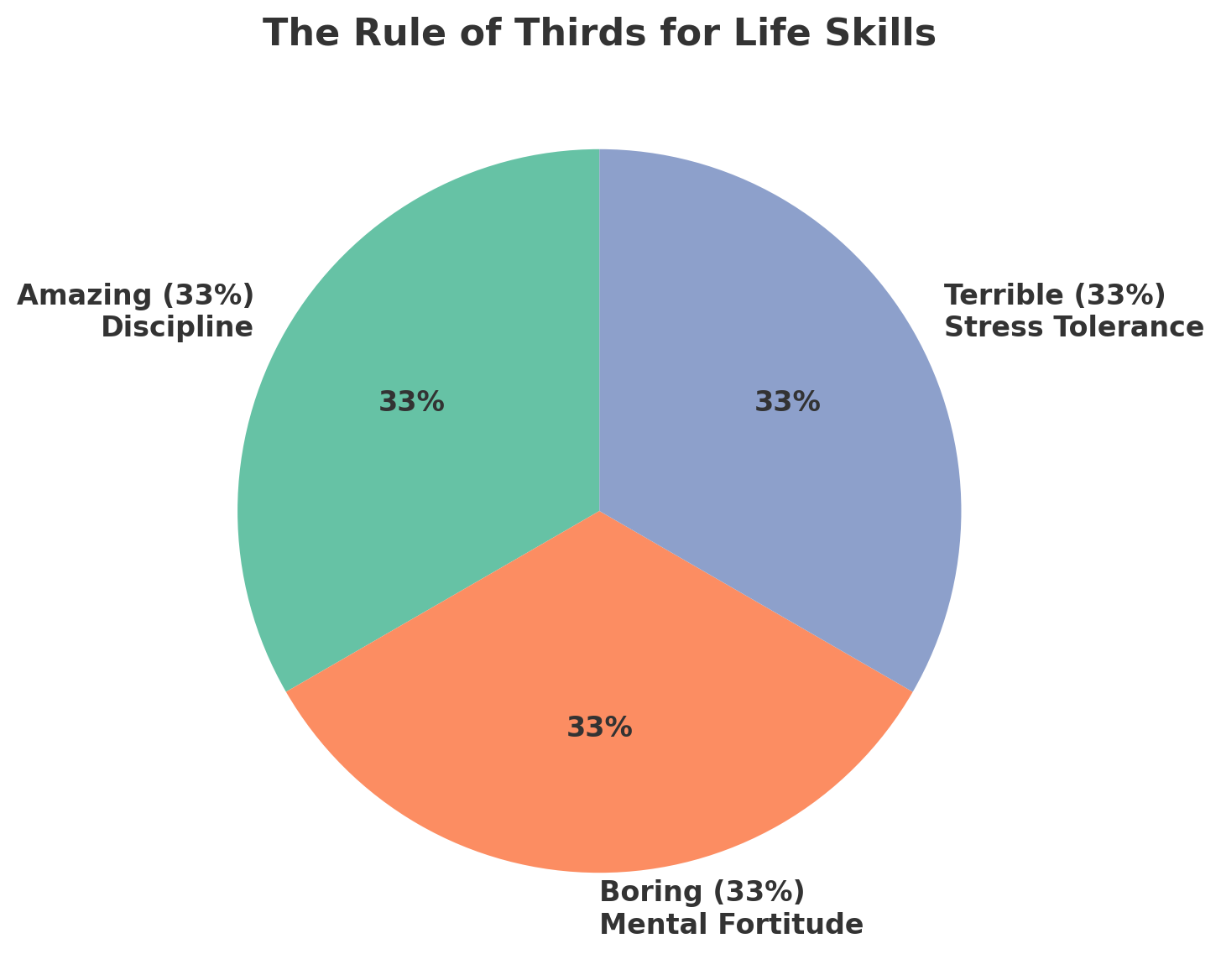
For the 33% that's amazing: You need discipline to capitalize on momentum and good circumstances.
For the 33% that's boring: You need mental fortitude to stay productive — or remain comfortable while wholly unstimulated — when nothing feels exciting.
For the 33% that's terrible: You need stress tolerance to perform under pressure and navigate adversity.
And when your emotional regulation and stress tolerance don’t meet your potential, you get in your own way.
But also, the moment your emotional regulation catches up with your potential, nothing stands in your way.
I know this because the rule of thirds applies especially well to startups. And as a founder, I’d argue the scale often skews heavily away from amazing for different stretches of time.
The mathematics are brutal. But they are simple.
NO DUMB QUESTIONS
When I was younger, I asked my (now) 87-year-old uncle how he maintained his morning workout routine despite a demanding job and abundant personal life. His response influenced how I think about discipline forever:
"When I do something, I avoid the dumb questions."
He was being cheeky, but he wasn't wrong. For most things in life, the barrier isn't difficulty level — it's the energy we waste negotiating with ourselves about whether to start.
My uncle had eliminated decision fatigue by making the decision once instead of making it every morning. He didn't wake up and debate whether to exercise. He woke up as someone who exercises. At dawn. Daily. And for decades.
Studies confirm what my uncle knew intuitively: getting started consumes more neurological resources than continuing.
Each choice is a step carving the path you’ll eventually call your story.
Discipline isn't built through grand gestures — it's constructed through a million tiny choices that compound into the story of your life.
DISCIPLINE BEATS TALENT
But in a world where talent earns clicks, likes, and views, discipline often falls by the wayside. It’s the silent hanger that holds talent in place — essential, but rarely celebrated. And like a coathanger, your work crumbles without it.
In 2002, scientists discovered that self-control predicts academic achievement better than IQ. The capacity to regulate attention, emotion, and behavior in the presence of temptation consistently outperforms raw intelligence.

When I stumbled upon the research, I recalled something my mom repeated to me as a kid. “Be resourceful with everything except paper, Layla – especially when it comes to math. There is nothing that responds better to repetition than learning math.” She was right. The most disciplined person in the room beats the smartest person in the room.
Your ability to manage yourself matters more than your natural ability. And your ability to manage yourself lies heavily on your perception of yourself.
Because consistency is your only advantage.
PROCRASTINATION IS NOT A TIME MANAGEMENT PROBLEM ITS AN EMOTIONAL REGULATION PROBLEM
Stop buying planners and downloading productivity apps and trying to manage your time better. High self-control individuals aren't born with superhuman willpower. They're simply better at managing negative emotions without avoiding the task at hand. Because most hard things are not inherently hard. Getting started is 50% of the cognitive load.
But when you’re a dopamine addict, addicted to the thrill of a hit — disguised as a Tiktok — or when there is a knowledge gap between what you need to do and where you are, you freeze. You do other things. Neuroscience reveals that procrastination is essentially poor mood regulation disguised as laziness. It's your brain choosing "feel good now" over "feel proud later."
I recently learned that scrolling lights up the same part of the brain that pulling a slot machine does. The anticipation of what’s next keeps you excited. TL;DR, we are addicts — but are gambling with our lives. And until we get a grip of it, we are cooked.
The solution isn't more willpower. It's better emotional regulation skills.
Your procrastination isn't a time management problem — it's an emotional regulation problem.
Instead of judging yourself for lacking discipline, you can develop the emotional intelligence to notice what you're avoiding and why. What’s scaring you? Do you think you’ll fail? Does the silence of boredom directly interfere with the normalcy and expectation of chaos you developed in your childhood?
Do you agree that procrastination is often linked to poor emotional regulation?
YOUR BODY IS THE MOST ACCURATE REPORT CARD
If you want to see what your daily decisions really cost, look in the mirror.
New research from Finland tracked individuals from age 27 to 61, revealing something profound: cumulative behavioral patterns have far stronger health associations than current behaviors alone. Your body doesn't just reflect what you did yesterday — it's the physical manifestation of millions of tiny decisions made over decades.
Those who consistently smoked, drank heavily, and avoided exercise didn't just receive health warnings. They lived measurable consequences:
38% more depressive symptoms than healthier peers
1.5x higher metabolic risk for diabetes and heart disease
Nearly a full point lower self-rated health on a five-point scale
Significantly reduced psychological well-being in daily life
Bad habits don't work solo. They orchestrate together to compound your suffering.
The flip side: good habits compound the same way.
EIGHT DECISIONS THAT ADD 24 YEARS TO YOUR LIFE
Science has quantified longevity. Adopt these eight behaviors by age 40, and add 23-24 years to your lifespan:
Don't smoke
Move your body 30+ minutes daily
Consume alcohol moderately (My personal choice: abstain completely)
Eat predominantly whole foods
Maintain healthy body weight
Practice quality sleep hygiene
Develop effective stress management
Avoid opioid use
Notice something important: none of these require exceptional talent. All require consistent execution.
The gap between knowing what to do and actually doing it isn't an information problem. It's an implementation problem.
Hit the like button <3. It helps others find my work. THANK YOU!
ONE MILLION TINY DECISIONS IN PRACTICE
The research on micro-habits is staggering:
One minute of daily vigorous activity reduces mortality risk by 38% over six years.
A 15-minute post-meal walk cuts heart attack risk by 40%.
Even taking stairs instead of elevators measurably reduces disease risk, including cancer.
You don't need a complete life overhaul. You need faithful execution of tiny, strategic actions.
PERFECTIONISM WILL BE YOUR DOWNFALL
Sometimes you don’t start because you’re waiting for perfect. But perfectionism doesn’t push you to achieve more — it traps you into achieving less.
When perfectionists face challenging tasks, the fear of failure takes over. Instead of progress, they spiral into avoidance and disengagement.
In trying to avoid failure, perfectionism guarantees it.
Perfect becomes the enemy of done. Done becomes the enemy of started. My uncle understood this when he eliminated the "dumb questions" that keep most people stuck in the planning phase.
MAKE IT WHO YOU ARE
The research-backed hack: when goal-directed behaviors become habitual, action initiation transfers from conscious motivation to automatic response. Once behaviors become truly habitual, you no longer need motivation to maintain them. The habit becomes integrated into your identity.
Instead of "I want to exercise," you become "I am someone who moves daily."
Instead of "I should eat better," you become "I am someone who nourishes my body."
Instead of "I need more discipline," you become "I am someone who keeps commitments to myself."
The semantic word play transforms into neurological rewiring.
YOU HAVE 936 WEEKENDS
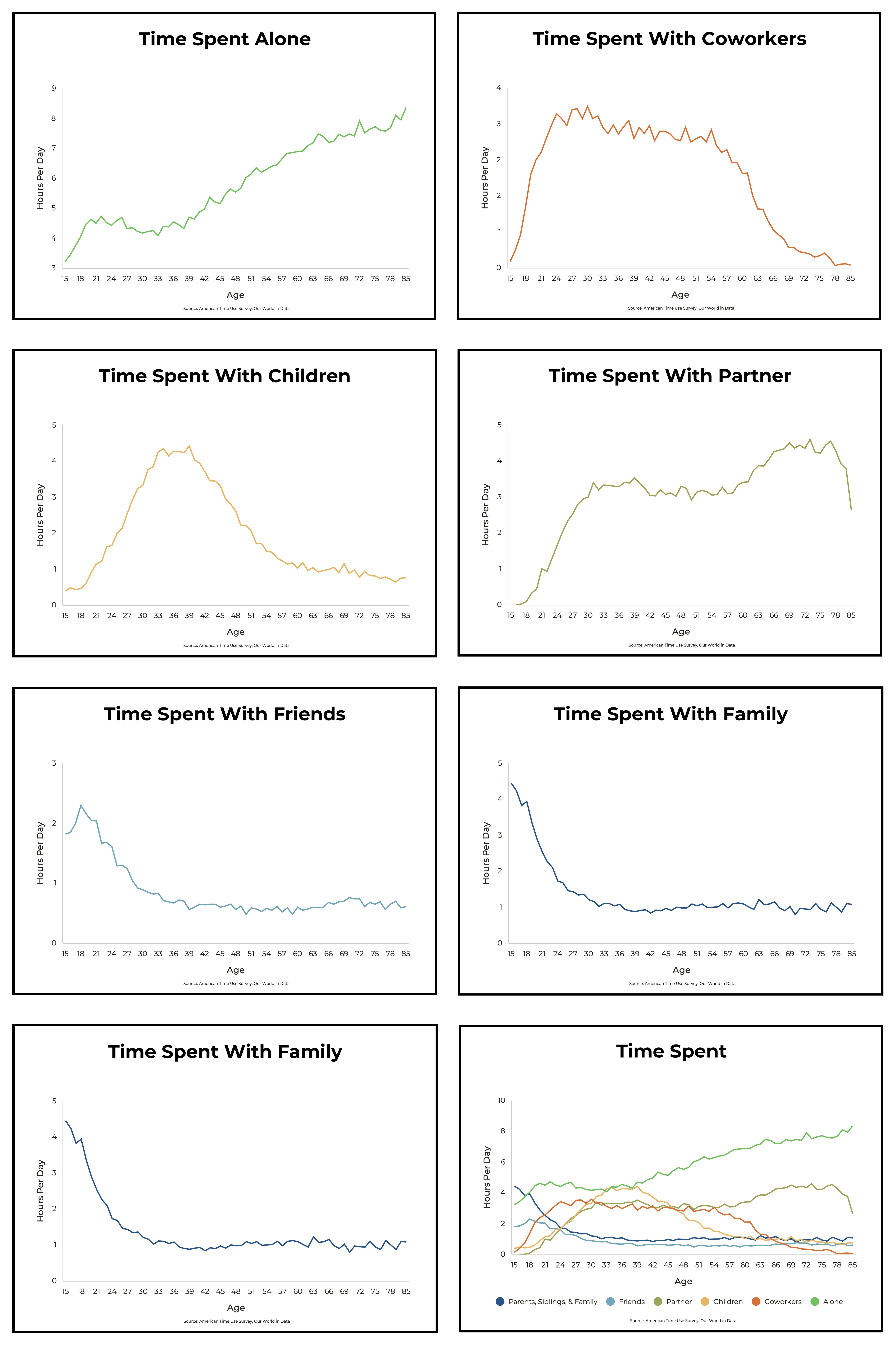
You get exactly 936 weekends with your child before they turn 18. Meaning, you might change your LED lightbulb two times before they are out of the house and off to college.
Every interaction is simultaneously ordinary and irreplaceable. Every moment you model emotional regulation, they're learning how to manage their own inner world. Every time you show them consistency over perfection, you're giving them permission to be human while still pursuing excellence. During your 66% of average and bad moments, has your reaction led to fear or growth in your children?
Your daily decisions aren't shaping your life and teaching your children what's possible for theirs.
EVERY DECISION IS AN INVESTMENT
My uncle told me what behavioral science now proves: small actions, repeated consistently, compound into extraordinary results over time.
Every decision is a penny invested. Some buy lottery tickets — instant gratification with uncertain returns. Others go into savings — delayed gratification with compound growth.
A single penny won't make you wealthy. But how you invest millions of pennies determines whether you build lasting prosperity or stay financially broke.
The same principle governs your health, relationships, career, and character.
My uncle was right: avoid the dumb questions. Make the decision once. Become the person who doesn't negotiate with themselves about doing what they said they'd do.
You don't need motivation. You need systems. You don't need perfection. You need progress. You don't need tomorrow. You need the next ten minutes.
The person you're becoming is watching every choice you make today.
YOU READ THE WHOLE THING! Thank you 🙏 Please leave me a like and a comment. It makes my day, and I thoroughly enjoy seeing the support.
Failure is a precursor to success, its almost never the other way around.
Fail, fail, fail Again. It keeps us interesting. Thank you for this!
Share Your Perspective offers collaboratively created content on a ton of topics. Please check us out.